
Three Steps to Heaven
Some photos and some words...

The moon descended
And I found with the break of dawn
You and the song had gone
But the melody lingers on
And on, and on, and on
And on, and on
from ‘The Song is Ended’ (but the Melody Lingers on) by Irving Berlin
When my wife Sarah and I moved to the small Wiltshire town of Chippenham some twelve years ago, we had no idea our house was so close to a monument to one of the Rock and Roll greats. That was a discovery made on our first evening as we left the house for a stroll and, within a couple of minutes, came across a small black metal plaque close to the ground dedicated to Eddie Cochran, the American rock and roll singer, guitarist, and songwriter whose short life produced some of the most enduring early rock classics.
Many people reading this may have heard of Eddie and his hits, such as 'Summertime Blues', which became a Rock and Roll classic covered by The Who and many others, or 'C'mon Everybody', an anthem of youthful freedom. More poignantly, his song, 'Three Steps to Heaven', released shortly before his death, became a posthumous UK No. 1 for Eddie.
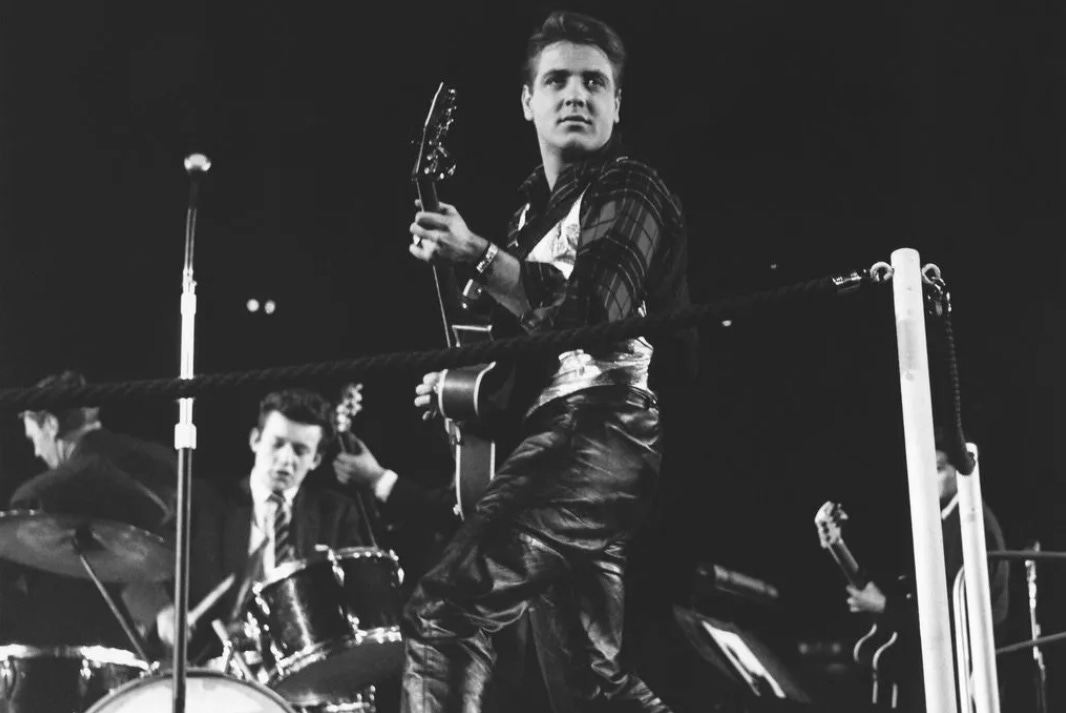
Eddie, born in Albert Lea, Minnesota, on this day in 1938, had an explosive, although truncated, career as a recording artist and performer. One peak of his brief career was his appearance in the Jayne Mansfield comedy 'The Girl Can't Help It' in 1956, when he was only 18. In the film, he performed a rockabilly number called 'Twenty Flight Rock,' which he performed with a slouch and jittery mannerisms meant to be tongue-in-cheek, as an example of the lack of talent required to succeed in rock and roll.
But Eddie had talent galore with his mix of teenage rebellion anthems, love songs, slick stage presence and innovative guitar playing. One of the pioneers of youth culture in music, he, alongside Buddy Holly and Gene Vincent, helped shape the sound of early rock. Eddie's songs captured teenage frustration, fun, and rebellion and influenced countless British musicians, including members of the Beatles, the Rolling Stones, the Who, and Led Zeppelin.
Paul McCartney has long credited Eddie Cochran's 'Twenty Flight Rock' as the song that truly kick-started his musical journey, as it was the song that Paul played for John Lennon that convinced the 17-year-old John that Paul should be in his band, The Quarrymen... "I think what impressed him [John Lennon] most was that I knew all the words... We used to go around shops and ask to hear a record… 'Twenty Flight Rock' was a hard record to get; I remember ordering it and having to wait weeks…"
Pete Townshend and Roger Daltrey both idolised Eddie, and 'Summertime Blues' was for years a Who stage-favourite. Explaining why it meant so much, Pete said, "The rock' n' roll songs I like, of course, are songs like 'Summertime Blues,' man, that's beautiful. It says everything: don't have the blues, it's summertime; summertime, you don't get the blues in summertime!" highlighting how Eddie's music perfectly captured the core themes of rock itself. Youth, freedom, and rebellion.
Vince Eager a British singer who toured with Eddie is quoted as saying "Not only was he an amazing guitarist, he was generally a brilliant musician… very generous… passing on his knowledge to other musicians." and Georgie Fame, who backed Eddie on tour, remembered "We were astounded… he could do all that brilliant finger-style stuff that Chet Atkins did… played this amazing intro to 'What'd I Say'… within six months, every band in the country was playing it." Brian Setzer echoed Eddie's style and played a Gretsch 6120 like his. Brian even portrayed Eddie in the film La Bamba, while Rory Gallagher cited Eddie alongside Chuck Berry as a foundational influence on his guitar work.
Eddie's influence extended beyond his own music. Joe Brown often praised Eddie as a great and innovative guitar player who introduced styles and techniques never seen in the UK before. Georgie Fame credits Eddie with introducing Ray Charles' music to a mainstream UK audience through his playing of Charles' songs in his stage act.
There is a degree of irony in the fact that, despite all the plaudits from the rock greats, Eddie's songs' C'mon Everybody' and 'Somethin' Else' only became big UK hits when the punk band 'The Sex Pistols' took them both to number three in the charts.
But what's the connection between Eddie and the little Wiltshire town of Chippenham? Unfortunately, it's a tragic one.
In early January 1960, Eddie came to Britain to join a UK tour with Gene Vincent (another US rock and roll star), which had already been on the road since before Christmas. While rock and roll was already popular in the UK, many British teenagers had only heard it on records or the radio, so seeing Eddie and Gene live was electrifying as they played venues across the country, including Newcastle, Bristol, Manchester, and London, thrilling crowds with their raw energy and guitar playing. Top pop impresario Larry Parnes promoted the tour while the support acts and musicians were all young UK rock and rollers that Parnes had under contract, including at various times Billy Fury, Joe Brown, Georgie Fame, Vince Eager and Johnny Gentle.
George Harrison of the not-yet-then Beatles saw Eddie when the tour played Liverpool and later acquired a piece of Eddie memorabilia. In 1999, Paul McCartney recalled the then-unknown Beatles touring Scotland backing Johnny Gentle. Eddie had given Gentle his stage shirt after what would prove to be his last show. Apparently, George pestered Johnny all week before Johnny eventually passed the shirt to George.
And there's another link between Eddie and a future British rock star. The then 13-year-old Marc Feld, an East London boy and the son of a lorry driver, met Eddie outside London's Hackney Empire, where he had just played a concert on the tour. Eddie allowed the boy to carry his guitar out to his limousine. Marc Feld held Eddie so in awe that Marc later renamed himself Dib Cochran as a jokey homage to the performer. However, it was as Marc Bolan with his band T. Rex that brought him fame as one of the earliest glam rockers.
The tour Eddie joined had a long, punishing schedule during the joy of a British winter, so by the time they all rolled up at the Bristol Hippodrome on Monday, 11th April for a week-long residency, Eddie and his fiancée, songwriter Sharon Sheeley ( who later wrote the Irma Thomas classic ‘Breakaway’) were looking forward to returning to the USA immediately afterwards. Billy Fury and Joe Brown played elsewhere for this final week of the tour; hence, the support acts included Georgie Fame, Johnny Gentle and Tony Sheridan, who would go on to make a record in Germany with an unknown Liverpool group called The Beatles a year later.
After the final show on Saturday, 16th April, Eddie and Sharon hoped for a lift back to London with Johnny Gentle, who had driven himself to Bristol, but his car was full. There were no more trains that night, so they decided to call a taxi and sometime after 11.00 pm, a Ford Consul driven by a George Martin, carrying Eddie, Gene, Sharon and tour manager Pat Thompkins, set off for London. Eddie, Sharon and Gene sat in the back, with Thompkins beside the driver.
These were pre-M4 motorway days, and Martin's exact route out of Bristol is unknown. Still, from what Thompkins later recalled, Martin probably took the A420 towards Chippenham rather than the main A4 through Bath, as it was a bad, unlit road. Once in Chippenham, I suspect Martin's plan was to pick up the A4 to London.
Thompkins recalled, "You come out from under the viaduct [In Chippenham] and come across a bridge in front of you. On your right is the A4 [back towards Bath] and then the bridge, and on your left is the A4 to London. Well, he saw the A4 and turned right, going the wrong way. When he saw the milestone, he realised he was going the wrong way and hit the brakes."
At this point, Martin, going at some speed, had reached the bottom of a hill leading out of Chippenham, nearby where our house stood. While breaking heavily, I suspect Martin then attempted some sort of turn, but misjudging his speed, lost control and spun backwards into a concrete lamp post. The severe impact caused Eddie's head to hit the car's roof while forcing the nearside rear door open, throwing him, Gene and Sharon onto the grass verge beside the road. After the car had come to a halt, Martin and Thompkins were able to walk away from the wreckage uninjured. Sharon suffered only shock and bruising, but Gene Vincent suffered severe injuries, including broken ribs and a collarbone, while also sustaining leg injuries. Sadly, Eddie suffered a fractured skull that would prove fatal.
The noise had brought residents onto the scene. One of these, Dave Chivers, told the Wiltshire Times: "I was getting into bed when I heard a whistling outside, followed by a series of bumps and smashes. My first reaction was that it was a plane crash. I went outside and saw the wrecked car, several people lying about, a large guitar and scattered photographs, which had come from the open boot. I telephoned for an ambulance from the kiosk nearby."
The occupants of our house at the time also heard the crash, and when they saw the injured, they took blankets out to keep them warm.
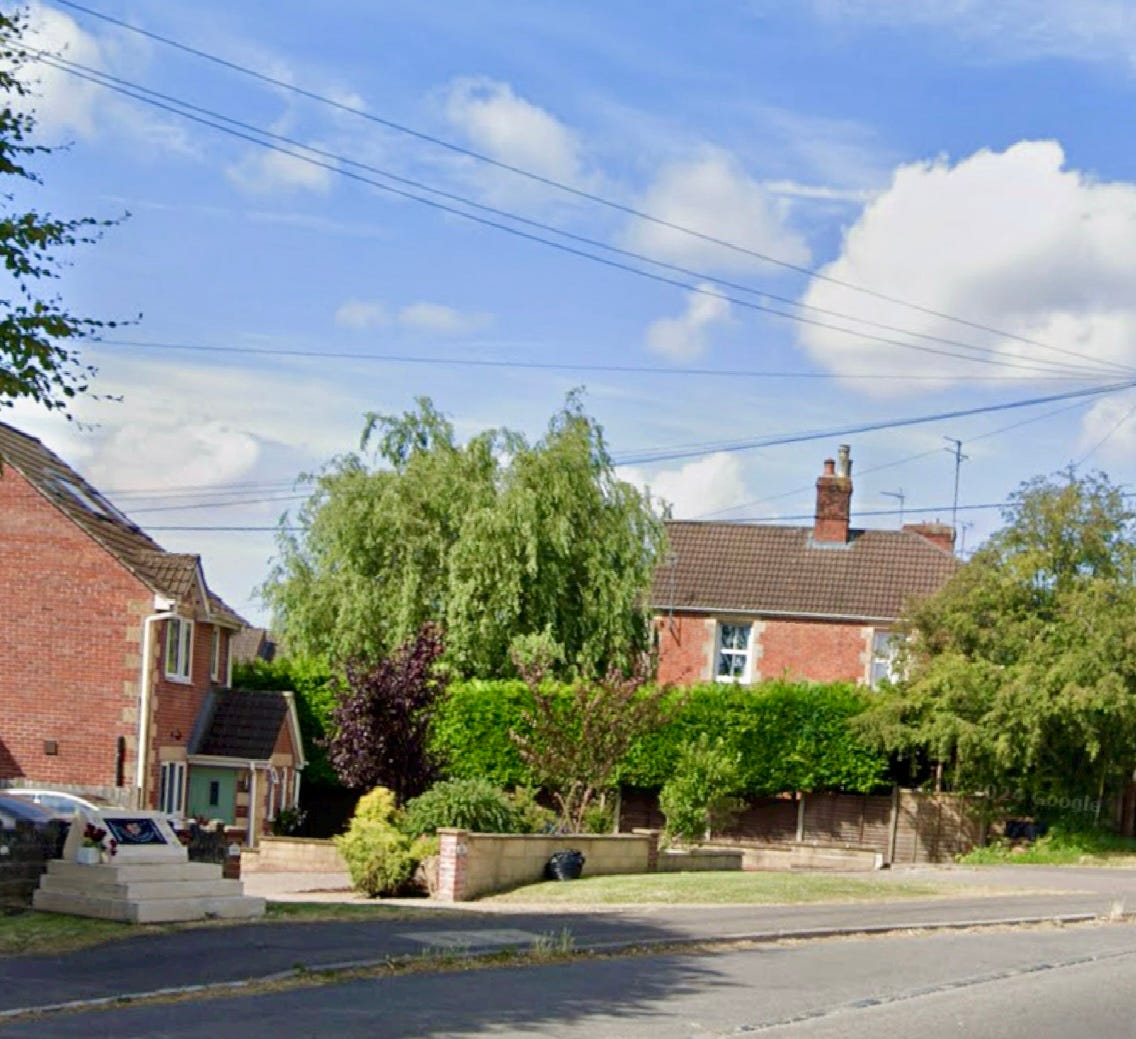
The first police officers on the scene included a young cadet named Dave Harman, who, with a name change, became a successful pop star himself, but more of him in a moment.
Eddie and Gene were rushed for medical treatment at St Martin's Hospital in Bath, yet, despite the efforts of doctors and medical staff, Eddie succumbed to his injuries. Having suffered severe brain damage, he never regained consciousness and died the afternoon after the accident. While Gene largely recovered from his injuries, those to his leg left him with a permanent limp. It's said he turned to alcohol, to help pain control, which played a significant factor in his own early death at the age of 36 in 1971.
A jury found the taxi driver George Martin guilty of dangerous driving, resulting in a fine of £50 (equivalent to around £1500 today), a 15-year disqualification from driving, and a six-month prison sentence. However, by some accounts, he served no time, and records show that his driving licence was reinstated only nine years after the accident.
The police impounded the car and other items from the crash at the local police station until the holding of a coroner's inquest. David Harman, the police cadet I mentioned earlier, in what to me seems macabre, taught himself to play guitar on Eddie's impounded Gretsch. He later became known as Dave Dee of the band Dave Dee, Dozy, Beaky, Mick & Tich. And I mentioned the carrying of Eddie’s guitar earlier in the tour by the young Mark Feld, later Marc Bolan of T. Rex, who, in a tragic coincidence, would himself die in a car crash in 1977. Today, the guitar is on display at the Rock and Roll Hall of Fame in Cleveland, Ohio, which inducted Eddie in 1987.
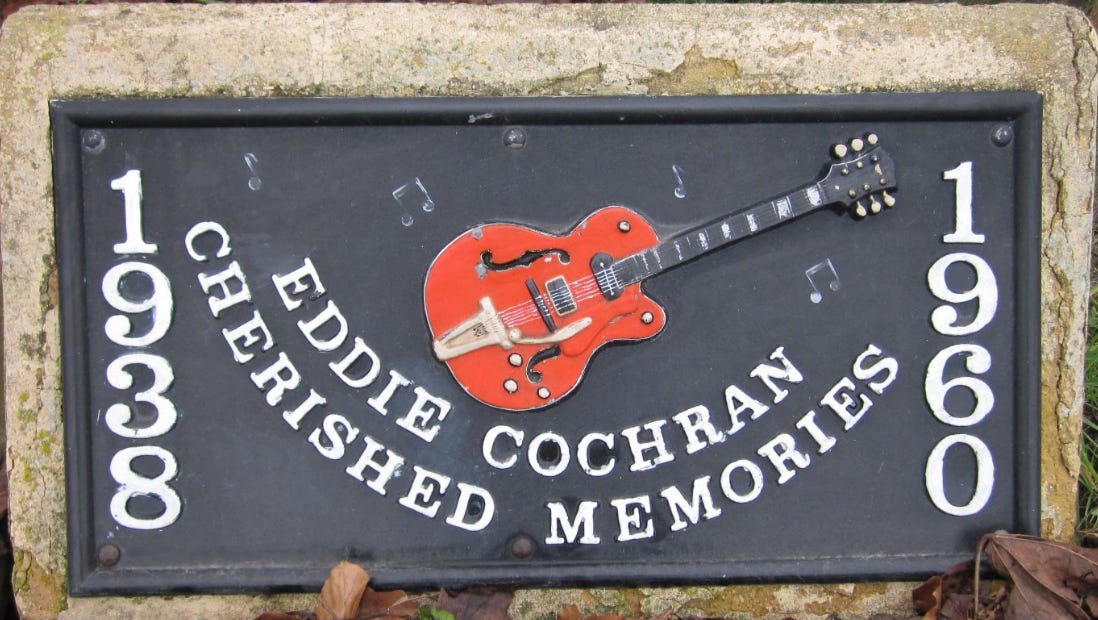
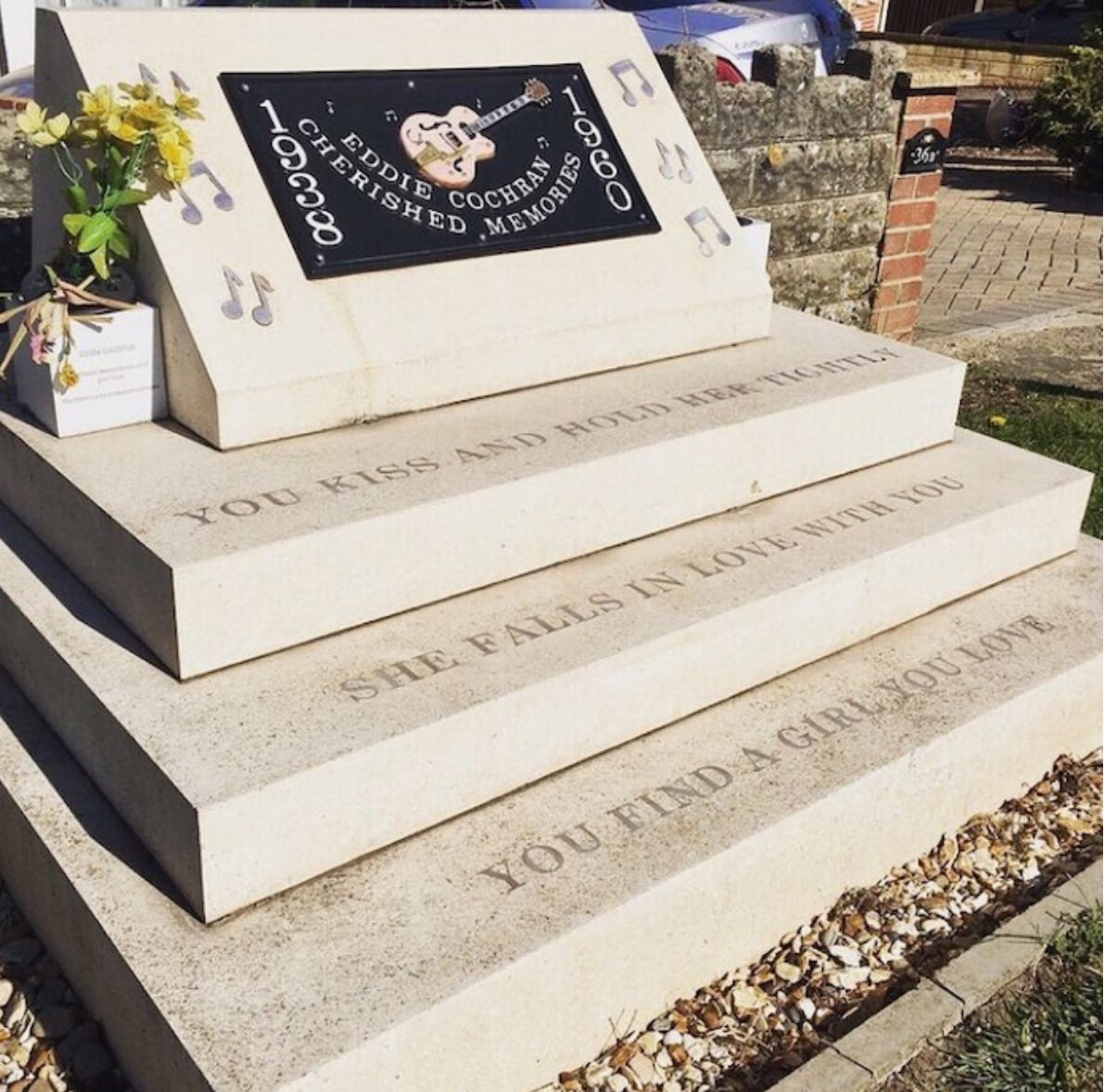
Fans erected the original small black metal memorial seen above to Eddie in 1998. Its unveiling was by Sharon Sheeley, on her first return to the scene since the accident. A grander version replaced it some twenty years later, with the original memorial moved for display in Chippenham Museum, where I volunteered for a few years after I retired. The design of the new memorial, seen below, features three steps, echoing Eddie’s hit ‘Three Steps to Heaven,’ with inscriptions of lyrics from the song adorning the steps. Before the larger memorial appeared, we often had fans knock on the door and ask where the less easily seen small memorial might be. They frequently carried flowers; whenever I passed the small monument, I'd see flowers and memorabilia by its side.
There is also a Blue plaque on the Bristol Hippodrome commemorating Eddie's final performance. Georgie Fame and Sherri Vincent, Gene Vincent's daughter, attended the unveiling to celebrate Eddie's legacy and reflect on what might have been.
St Martin's Hospital, Bath, too, has a memorial plaque as a quieter, poignant tribute near a sundial in the old chapel courtyard. The plaque commemorates Eddie's memory and the medical efforts made to save him. Even more than sixty years on, Eddie’s fans continue to support the hospital with donations.
In 2013, Eddie's fans also raised funds to donate a guitar to a school in Chippenham in his memory, with the aim that the donation might inspire new musicians
To paraphrase the title of the Irving Berlin composition, an extract I used at the beginning of this … the song may be ended, but the melody lingers on.
Great article, Harry. I was exposed to Eddie Cochrane because of the Sex Pistols and Gene Vincent because of Ian Dury. I'd no idea about these stories.
I didn’t realise you lived in Chippenham. I am down the road in Trowbridge. A former work colleague’s grandfather lived across the road and placed his own coat over Eddie as he lay on the verge. That coat or jacket, I believe, is now with the Eddie Cochran Society.