
Sublime Landscapes
A photograph, some words and some art....

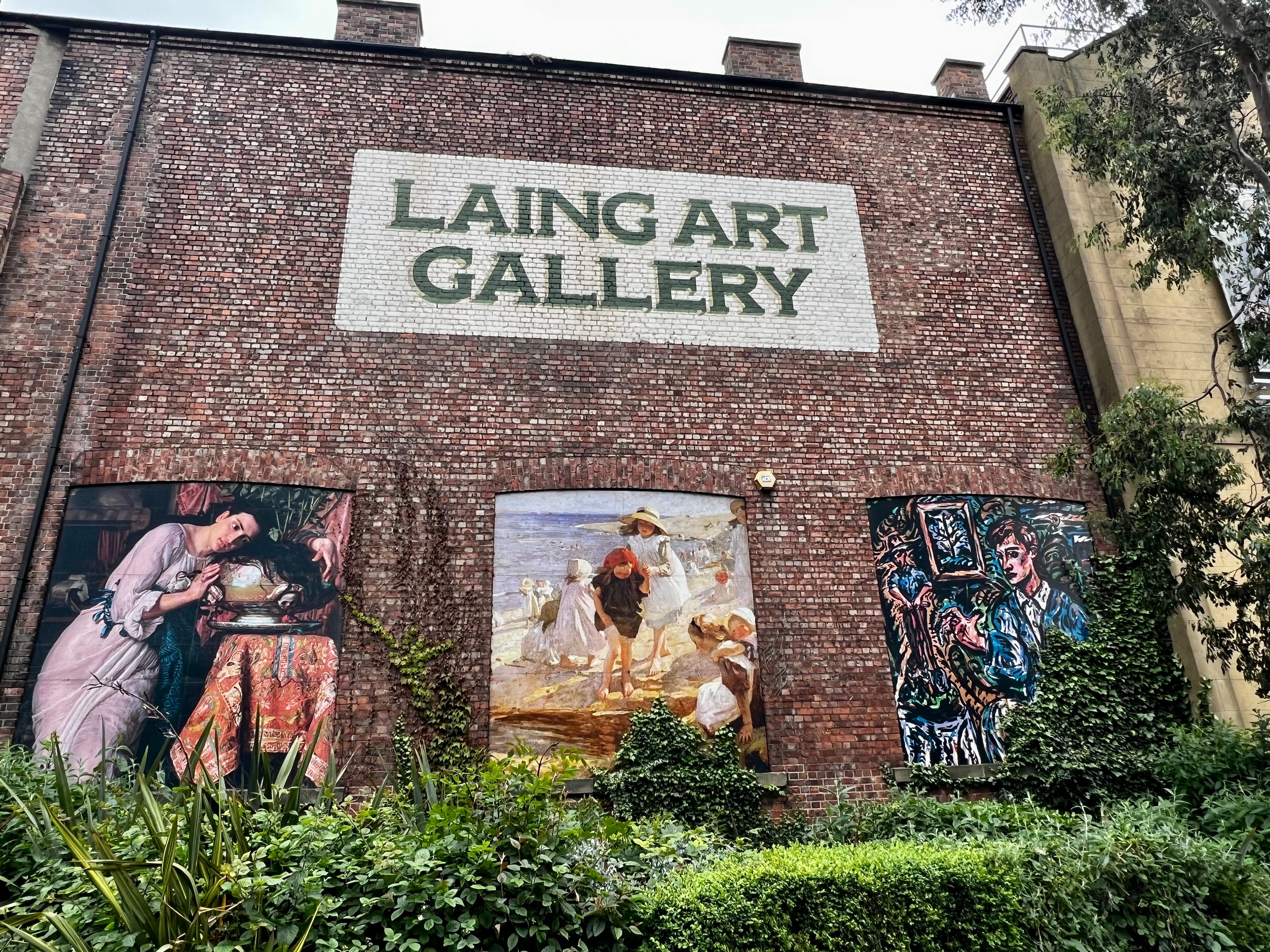
When I look out on such a night as this, I feel as if there could be neither wickedness nor sorrow in the world; and there certainly would be less of both if the sublimity of Nature were more attended to, and people were carried more out of themselves by contemplating such a scene.
Jane Austen - Mansfield Park
Earlier this week, I went along to Newcastle’s Laing gallery to view their newly opened ‘Sublime Landscapes’ exhibition that features landscape watercolours, prints and photographs from the Gallery’s collection that explore how artists have used landscape to evoke power, drama and emotion.
The idea of the ‘sublime’, deriving from nature’s capacity to inspire awe and wonder, first shaped British landscape painting in the eighteenth century and continues to resonate with some artists today. The concept encouraged artists to look beyond the idealised depictions of nature often found in pastoral landscapes and instead to emphasise nature’s vastness and grandeur, conveying the perception that it was beyond human control and comprehension. Some of these artists gravitated toward dramatic subjects, such as elevated mountain views and stormy seas, to elicit emotional responses in viewers, while others integrated sublime elements into more idyllic landscapes, a combined approach sometimes called the ‘picturesque.’
Regular readers may recall my ‘Meander’ from late 2024 on the Laing Gallery’s Romance to Realities: The Northern Landscape and Shifting Identities exhibition, which offered an intriguing exploration of the shift from idealised, romantic portrayals of Britain's landscape to more realistic depictions of daily life and social issues in 19th-century Britain that incorporated industrial and urban transformation. While this new exhibition has a different focus and scope, it is related as both demonstrate that the portrayal of landscape in art isn’t merely about scenery but a means of perceiving human experience through nature and the environment.
This new exhibition focuses on the sublime itself, presenting a narrative of how artists have evolved their initial interpretations of the sublime from 18th-century watercolours that evoke awe through their scale and drama to contemporary works that provoke emotional intensity through depictions of bleak landscapes and natural forces.
If viewed sequentially, the two exhibitions help visitors better understand why the sublime mattered to 18th- and early 19th-century artists as part of a Romantic early modern response to nature, and how, over centuries, the emotional and conceptual breadth of landscape art has shifted.
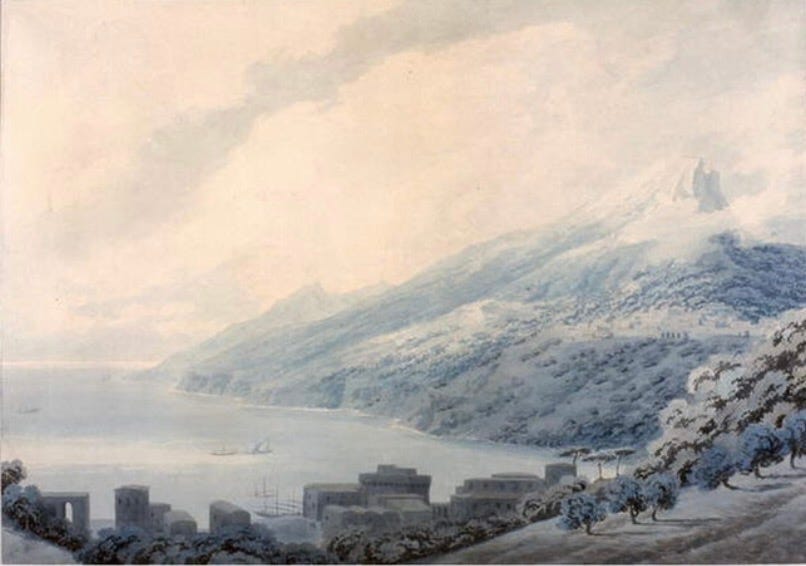
Let's turn to some of the pieces in the exhibition and of the early Romantics, one I particularly liked was John Robert Cozens’s ‘The gulf of Salerno - Raito to Vietri.’ Cozens was a pioneering Romantic watercolourist whose work helped define the sublime in British landscape painting. In the eighteenth century, many British artists toured continental Europe to experience the art and scenery of other countries. The watercolour below, from 1782, depicts the hillside village of Raito in Southern Italy and is based on a sketch made during just such a tour by Cozens. While the painting presents a calm scene, the prominence of the mountain peak on the right, partially obscured by cloud, hints at the sublime.
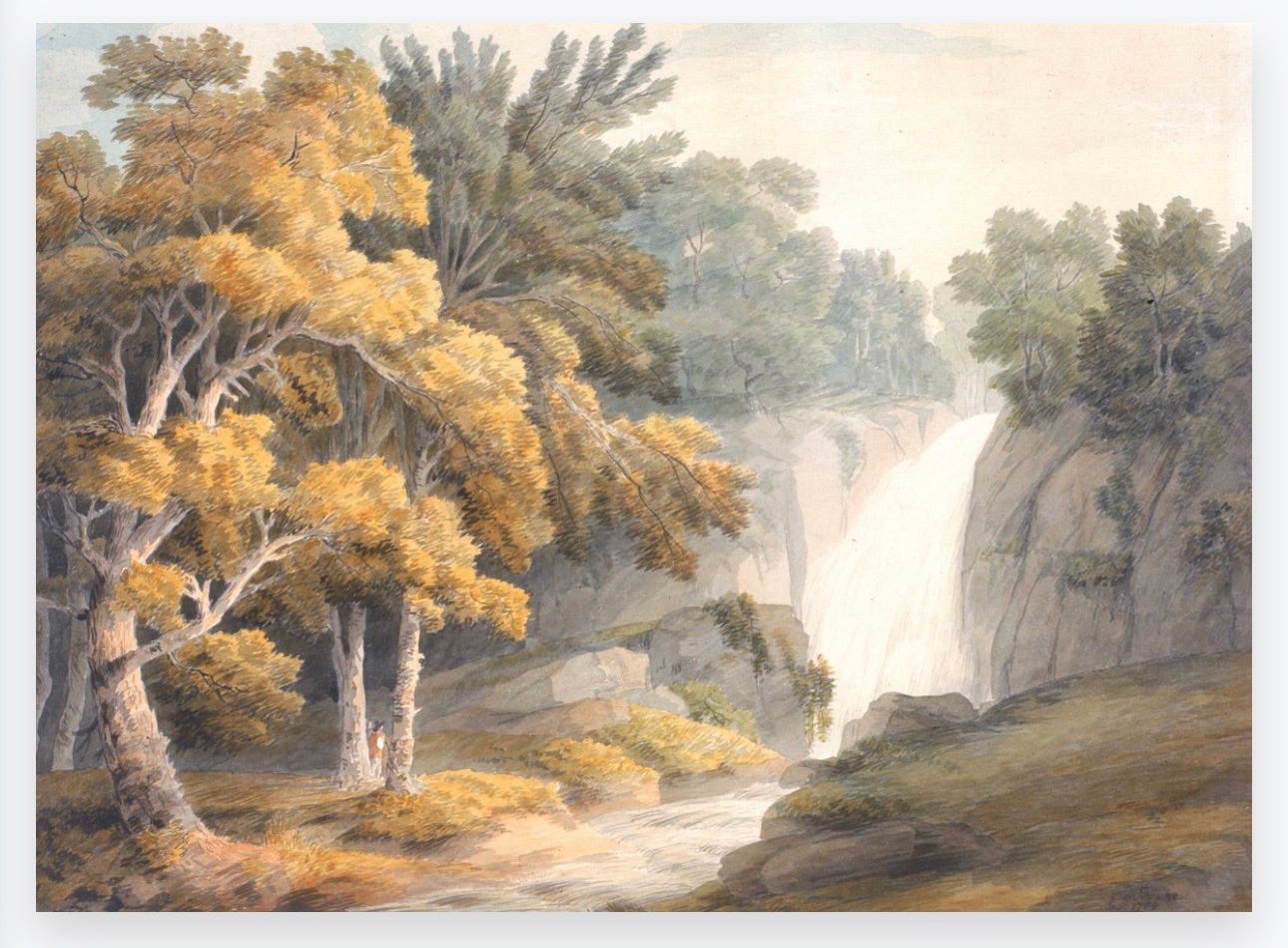
Another from that period that caught my eye was ‘A scene taken at Canonteign’ by Francis Towne, who was known for dramatic watercolours of natural features such as rugged hills, rocky terrain and tumultuous skies. Here, he captures a simpler scene of a waterfall at the country estate of Canonteign, a few miles from Exeter, where he was based. One of Towne’s contemporaries described the same view as, “noble rock towering most sublimely above the surrounding woods... I never met with a rock so compact, and of so beautiful a form, and taken in all its circumstances, so picturesque and romantic”.
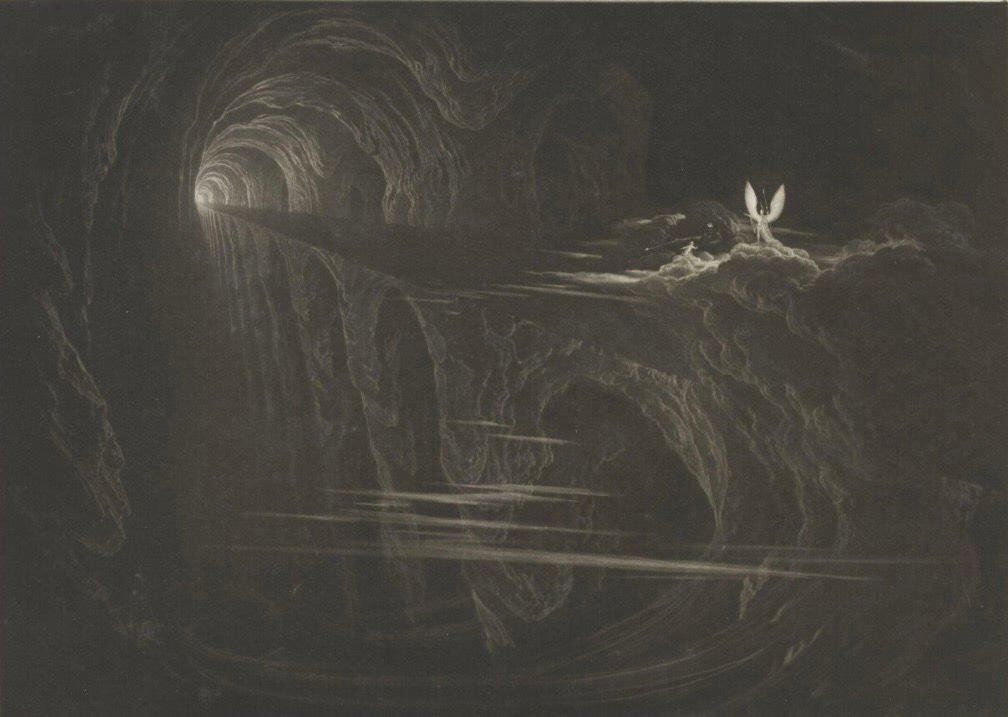
A painter with a long association with northeast England was John Martin, born in Northumberland and who began his artistic career in Newcastle as an apprentice to a coach painter. He became famous for epic, theatrical landscapes often populated with towering ruins or dramatic skies, and the Laing Art Gallery has several of his paintings in its permanent collection. However, in the case of this exhibition, one of his works on show is from the commission he received to illustrate an edition of John Milton’s 1667 poem ‘Paradise Lost’. Martin completed 24 engravings for an 1827 edition with illustrations now known for their epic quality and use of light and shadow. In ‘Bridge Over Chaos,’ Martin allowed his image to remain dominated by darkness, with the drama of distant light and the great drop below the bridge, designed to inspire awe and terror in the viewer. The illustration relates to a passage in the poem describing a new bridge across Chaos, which provided Satan with a way to pass between heaven and hell.
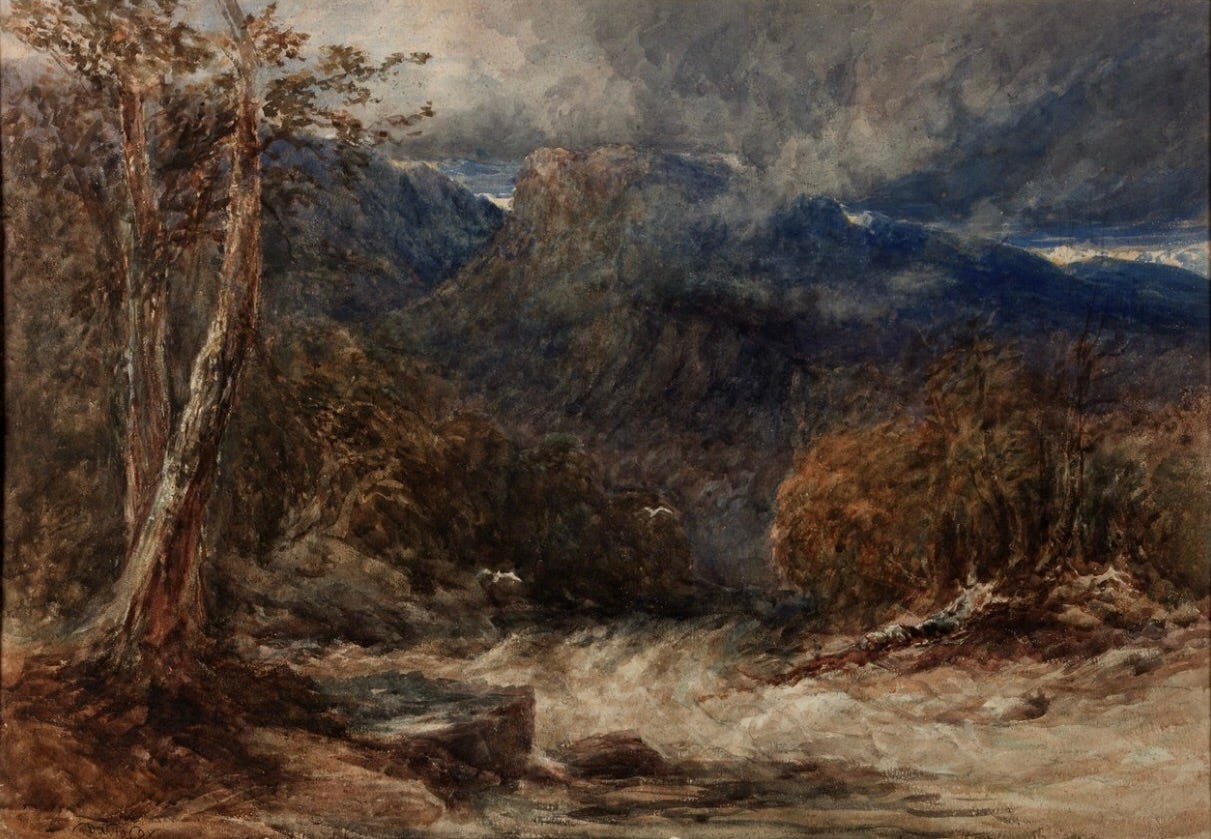
Moving on to later works, I much liked David Cox’s ‘The Meeting of the Waters’. Cox was a master of expressive watercolour landscapes and made regular painting trips to Wales, aiming to capture the mountainous landscape and unpredictable weather. In this large watercolour, Cox employs an ominous dark palette and expressive marks to depict unsettled mountain weather on a grand scale, creating an inhospitable place for travellers.
Another epic piece was Charles Napier Hemy’s almost life-size preparatory study, ‘Betrayed by the Moon,’ for a finished oil painting of the same title. The Russo-Japanese War of 1904 inspired Hemy to depict a Russian torpedo boat destroyer launching a nocturnal attack on a Japanese battleship, targeted because moonlight breaking through the clouds reveals its location. As with many of Hemy’s paintings, the sea is turbulent beneath a dark, heavy sky, suggesting that naval warfare can be awe-inspiring but horrifying.
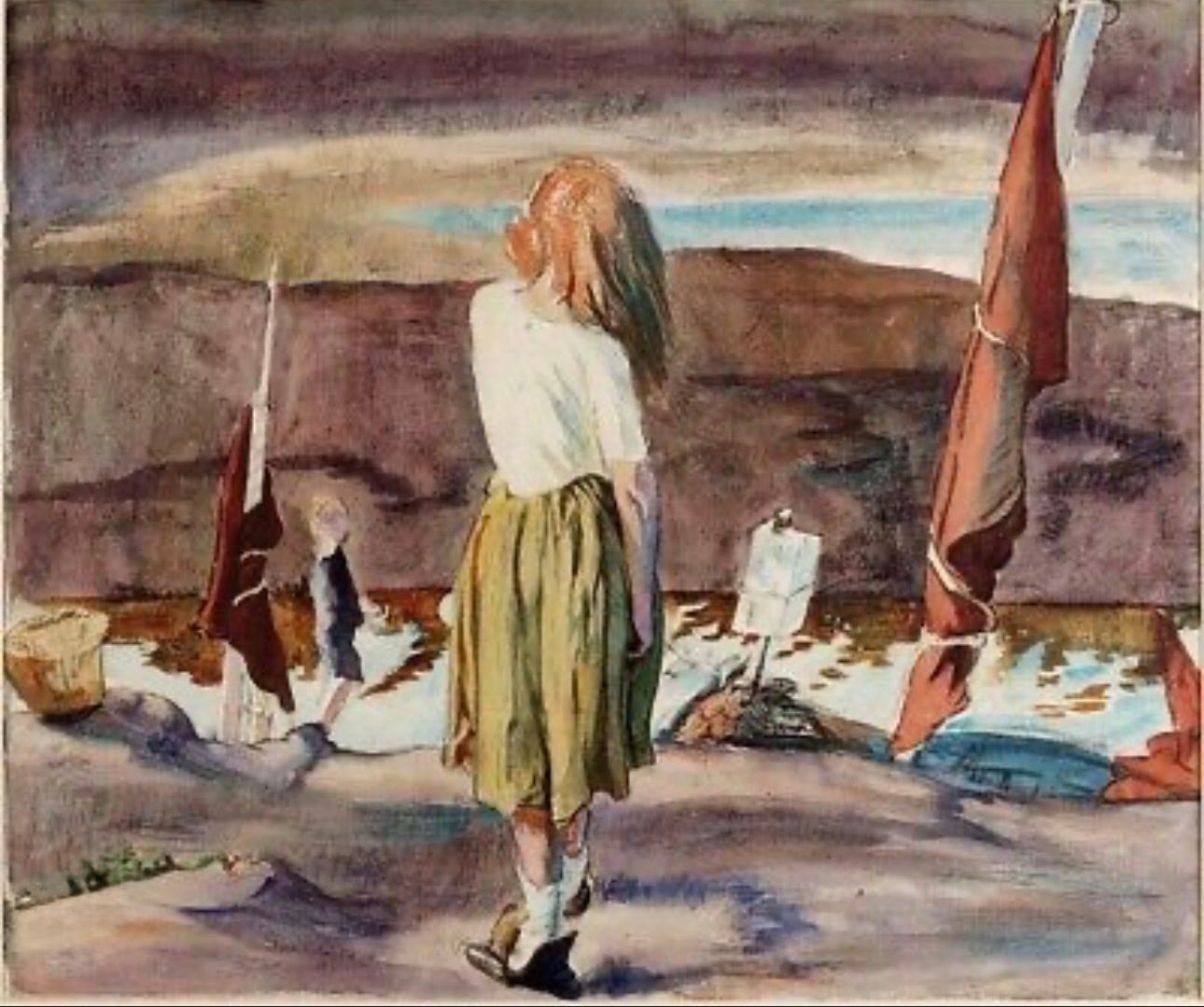
Yet another interpretation of Emily Brontë’s novel ‘Wuthering Heights’ is soon to hit cinema screens, and, by coincidence, the exhibition includes ‘Catherine’ by Lady Edna Clarke Hall. The Catherine in question is Catherine Earnshaw, the heroine of the book that fascinated Clarke Hall, and here, she depicts Catherine standing in a moorland landscape. The muted colour palette and wet-on-wet watercolour technique creating an uncertain emotional atmosphere.
A modernist take on landscape comes from ‘Limestone Quarries, General view II’ by Graham Sutherland, who made many views of quarries and mines while working as a War Artist during the Second World War. In this piece, the fiery red of the sky imbues the otherwise almost monochromatic scene with an unsettling atmosphere. The limestone cliffs below the sky appear bright white, while the people working with the stone seem elongated in a surreal, hellish work. environment.
Finally, works newly acquired for this exhibition bring the idea of the sublime into the context of contemporary concerns such as climate change and isolation. These acquisitions were made because they not only resonate with the gallery’s historic watercolour collection but also support its aim of expanding its holdings of contemporary works by women artists.
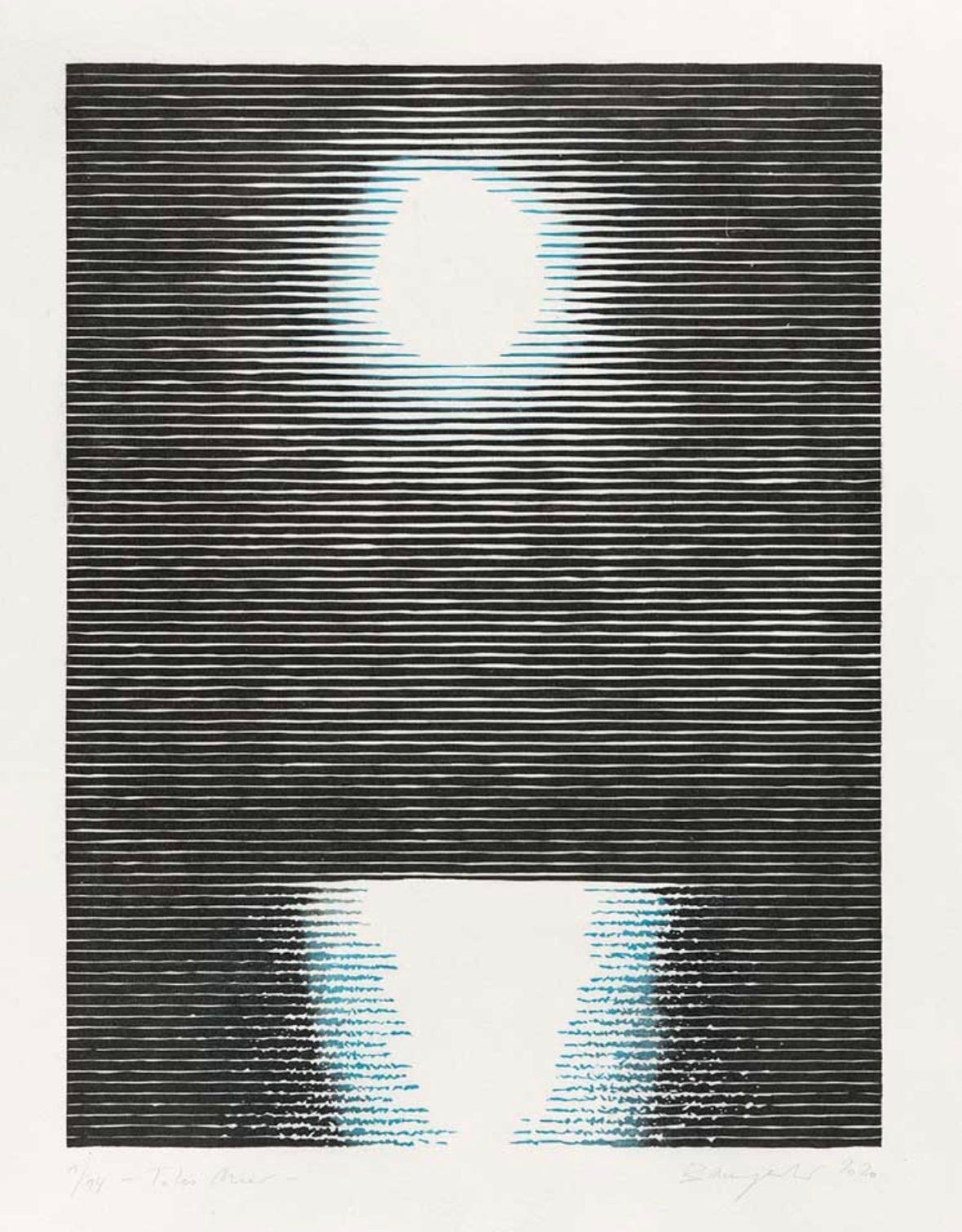
Christiane Baumgartner’s ‘Totes Meer’ (‘Total Sea’) is a large-scale print by the leading German artist known for woodcut and printmaking. Christiane transfers computer-edited images from her own photos and videos onto large woodblocks, then hand-cuts the blocks for printing, thus combining the contemporary aesthetic of digital images with traditional methods.
The piece offers a modern take on the sublime vastness of a sunrise over the Dead Sea. The sea is calm, and the sunlight is intense, with strong tonal contrast from the black ink that dominates the surrounding sea and sky, highlighting the brightness of the reflection.
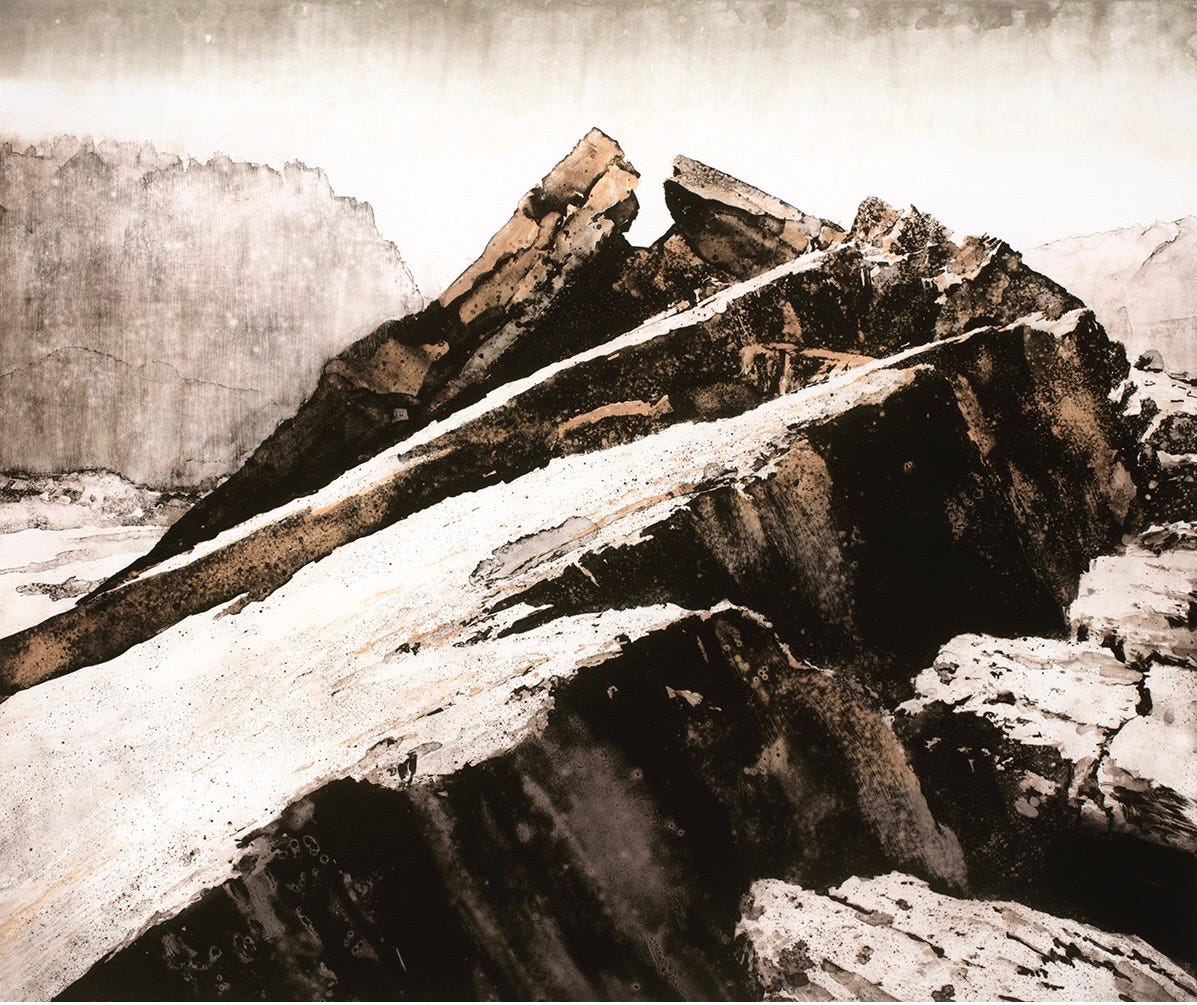
Another new piece is ‘Broken Terrain’, a mixed-method intaglio print from Emma Stibbon, whose artistic process includes field research, often with geologists and scientists. Of this piece, Emma has said, “I made Broken Terrain in response to a residency on Big Island, Hawaii, in 2017. I stayed on the rim of Kilauea, one of the world’s most active volcanoes. It depicts the broken lava pavement of Kilauea Kiki, a side eruption to the main volcano crater. Walking on this unstable crater floor felt precarious, and the ground was literally hot beneath my feet. Whilst out walking, I gathered volcanic ash to create a tactile surface in the print. I wanted to give a sense of the elemental terrain in the physical surface of the work!”
Two other pieces from Emma are ‘Whaling Station Deception Island’ and ‘Reynisdrangar.’ ‘Whaling Station Deception Island’ is a woodcut print, made on a monumental scale, of a building on an Antarctic island where commercial whaling took place in the early twentieth century, before the market for whale oil collapsed. An active volcano caused the island’s buildings to fall, and Emma has spoken of her attraction to landscapes that offer a tension between natural and man-made forces. By focusing on the collapsed building, this piece suggests the dominance of natural forces.
In ‘Reynisdrangar,’ Emma explores a fragile yet extreme landscape in transition by depicting the basalt sea stacks of Vík í Mýrdal, carved by sea erosion along Iceland’s southern coast.
The above is just a small selection of the many pieces on view in this well-curated exhibition (which, for information, runs through 2026), and which, for me, succeeds in conveying not just captivating or arresting scenery, but how artists use landscape to provoke emotion and reflection and how the sublime tradition has followed an arc from Romantic-era explorations of nature’s grandeur to contemporary concerns about environment and human impact.
Beautiful, just beautiful, Harry. Your post was so comprehensive, I feel as though I accompanied you to The Laing. The watercolors and paintings are so stunning! Thank you very much.
Lovely to discover your Substack, Harry, after commenting alongside you on Marianne's American observations on British life.
Have you read "Weatherlands", by Alexandra Harris? How weather/clouds etc have been depicted by English writers and artists since Roman mosaics and the first poetry in "English" in the 8th century. A wonderful book.