
Arthur "Kwame" Wharton
Some photographs and some words....

..” he runs like an express engine with full steam on...”
The Darlington and Stockton Times writing of Arthur Wharton
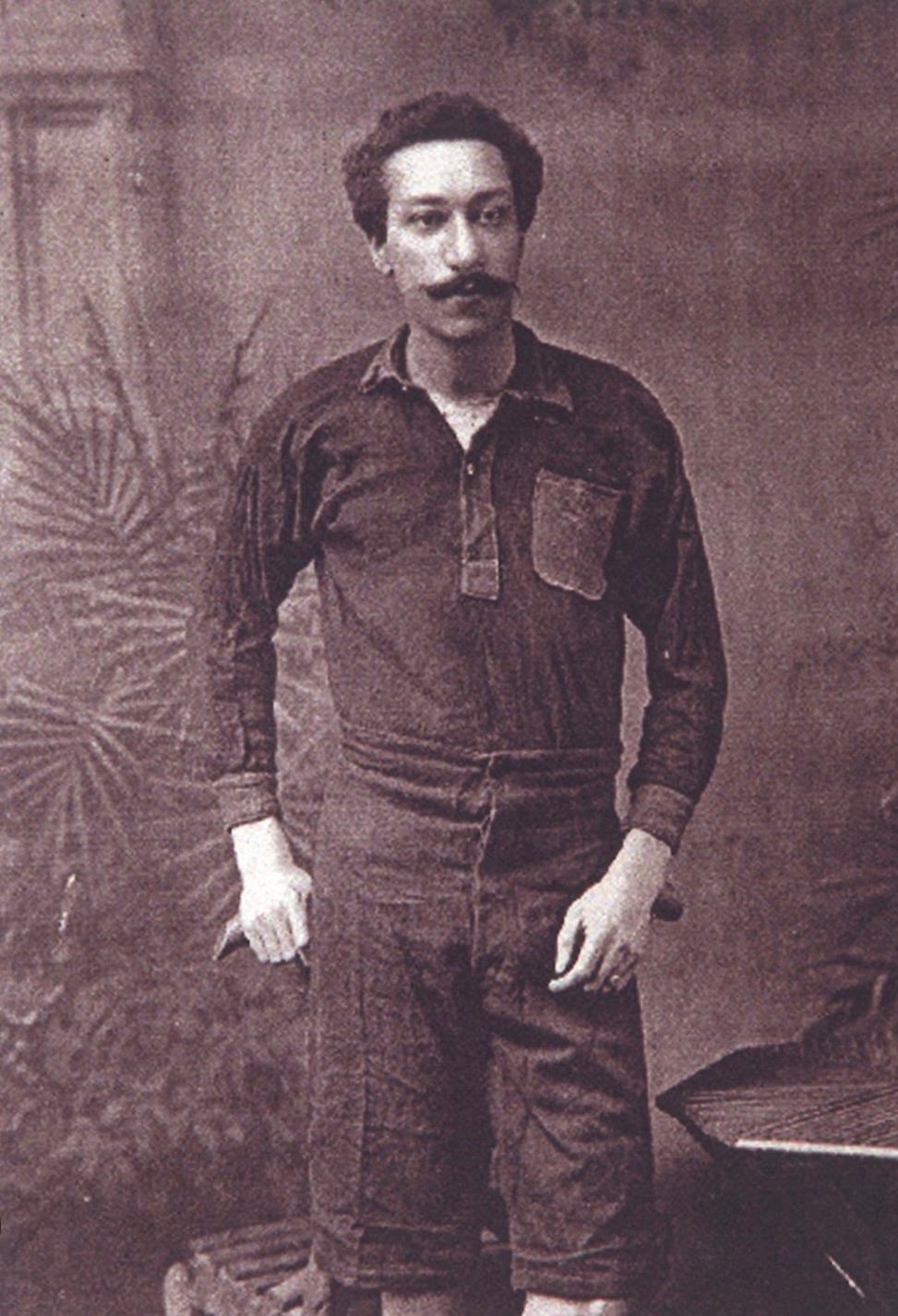
In the recent World Cup, Ghana held out solidly against England and, had refereeing decisions gone more Ghana’s way, they might well have sneaked a win. Many Ghanaian players have also become household names playing in the English Premier League, but long before them came Arthur Wharton, a now somewhat unknown figure, yet once regarded as one of the great pioneers of modern sport: the world’s first recorded fastest man and the world’s first black professional footballer, when organised football was in its infancy.
Born in October 1865, Arthur’s father, Henry, was a Grenadian who moved to what was then the Gold Coast (now Ghana) as a Wesleyan minister, while Arthur’s mother, Annie, was born into an influential Gold Coast family.
Henry died when Arthur was just eight years old, and his uncle stepped in to look after his education alongside Annie. That education began at the prestigious Mfantsipim School in Ghana, the same school that many years later the former Secretary General of the UN, Kofi Annan, attended.
While accounts differ slightly over the precise circumstances and date of Arthur’s first arrival in Britain, common belief is that his education continued at Dr Cheyne’s School in London between 1875 and 1879.
After spending time with his family in Grenada in the West Indies, Arthur returned to Britain in 1882 to train as a missionary teacher at Shoal Hill College in Cannock, Staffordshire, before moving the following year to Darlington, a town in northeast England, to attend Cleveland College.
Darlington arguably became the place where Arthur’s British sporting story really began, as it was while at Cleveland College that he discovered his extraordinary natural talent for sport. That talent would completely transform the course of his life.
Arthur began his sporting career in 1883 as a goalkeeper for the Darlington Cricket and Football Club under a man called Manny Harbron. It was Manny who discovered that Arthur was an outstanding track athlete as well as a great goalkeeper and became his mentor.
After competing in local track competitions, Darlington area newspapers started to suggest Arthur could win the national sprint title, and it was clear he should be competing at the highest level.
And, just as an aside, a little on Darlington that became famous for its role in the birth of the railway age. In 1825, the Stockton and Darlington Railway, the world’s first public railway to use steam locomotives for both passengers and freight, opened with Locomotion No. 1, designed by George Stephenson, making its first historic journey from Darlington to Stockton.
By the time Arthur moved to Darlington, the railway had transformed it into a major industrial centre, particularly for locomotive building and railway engineering. As the 1800s progressed, the railways had helped develop sports such as cricket and football into the professional leagues and associations that we recognise today. While these sports had their origins before the growth of the railway network, it was that network that provided the opportunity for teams to travel greater distances to play other teams and for supporters to go along to watch.
For example, cricket’s All England Eleven was travelling by train as early as the 1840s, promoting the game to a larger audience, while the English football league, established in 1888, saw teams travel across the country to play fixtures. Railway companies welcomed regular, profitable passenger traffic and catered for spectators by providing special excursion trains to popular sports events, such as the London-based FA Cup final.
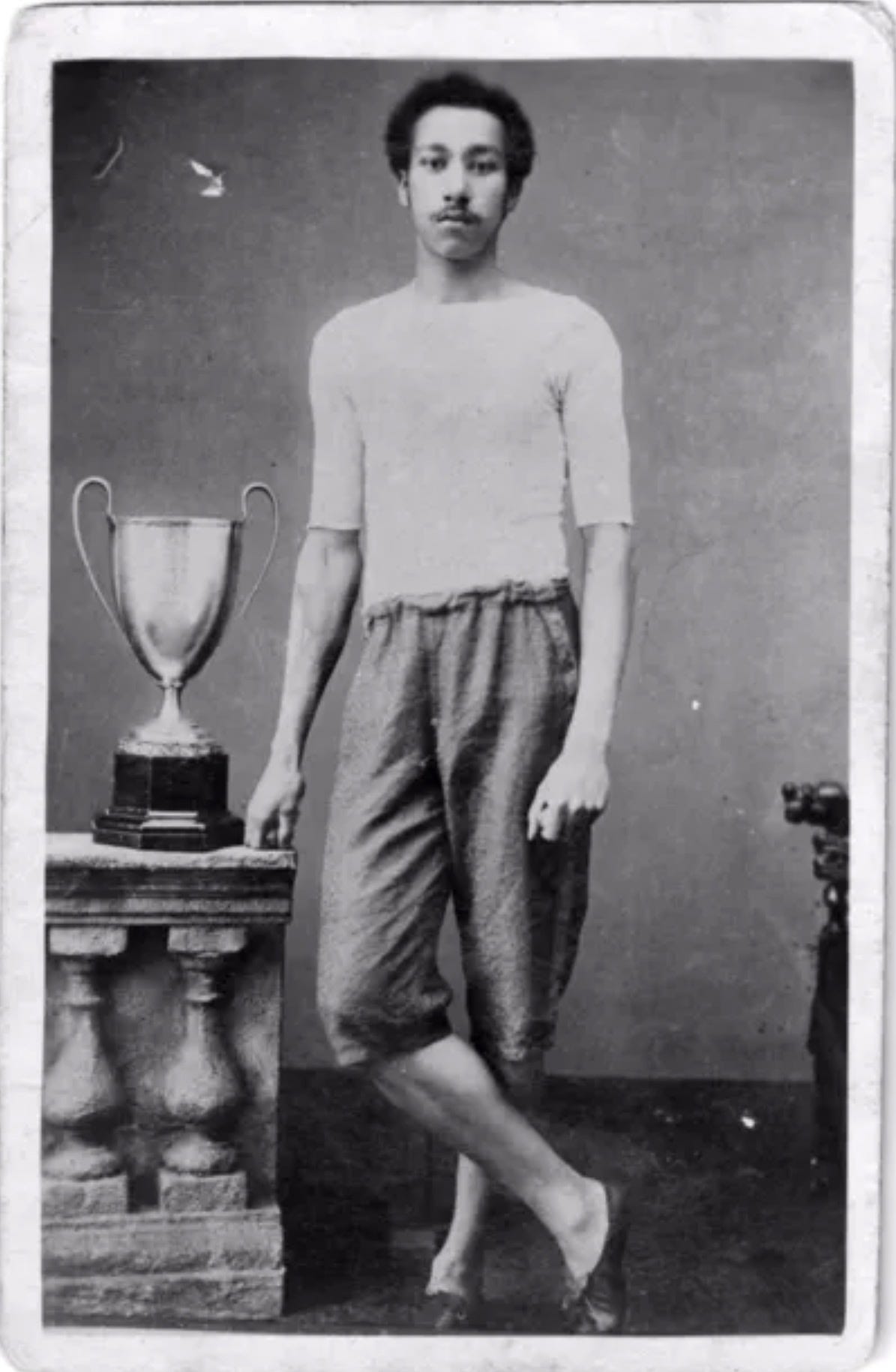
But let’s get back to Arthur, athletics and the Amateur Athletics Association (AAA), established in 1880 at a time when the sport was rapidly growing in popularity. On 3 July 1886, Arthur competed at the AAA Championship at Stamford Bridge in London, running in the 100-yard sprint and becoming the first black AAA champion by winning the Prince Hassan Pacha Cup with a recorded time of 10 seconds dead and thus the world’s first official fastest man. The following year Arthur successfully defended his title after equalling his own world record at Sturbridge Cricket Ground, a record that stood for more than 30 years.
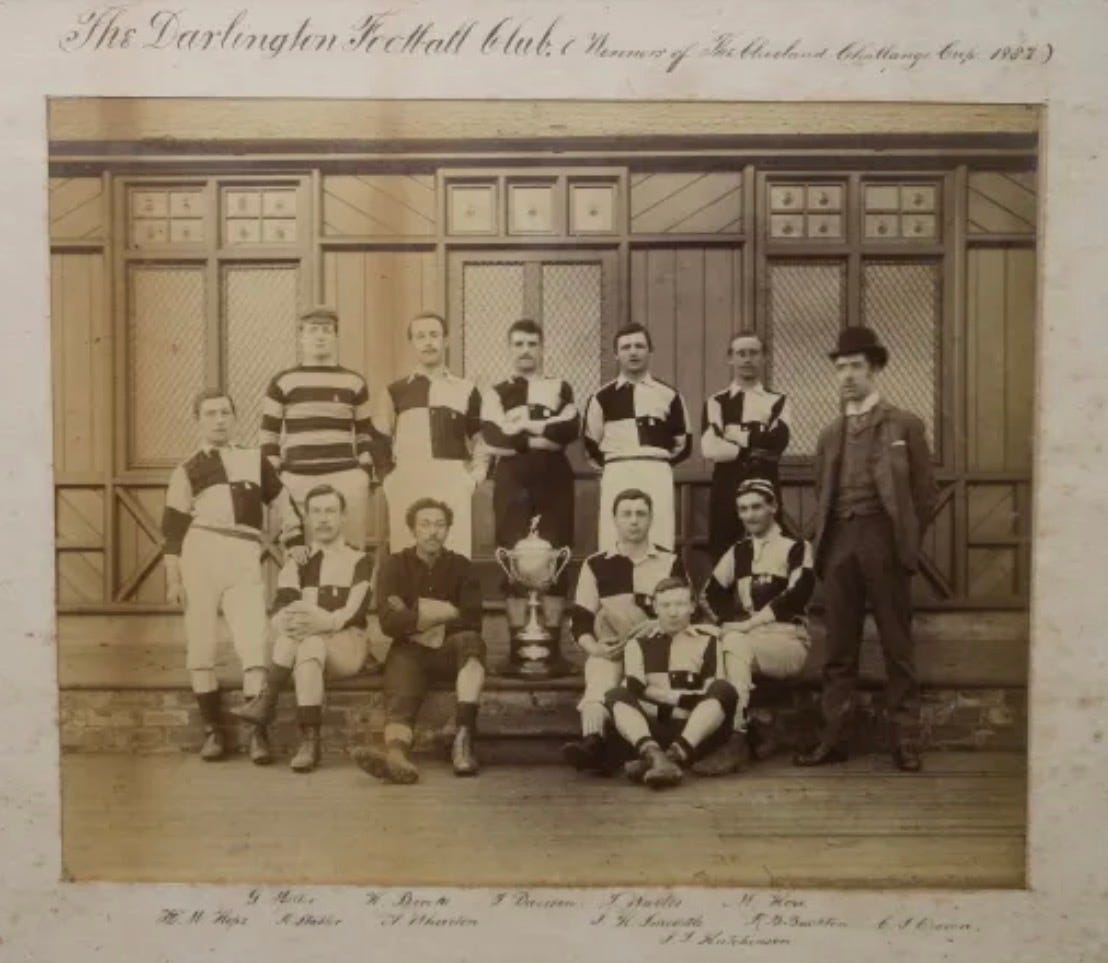
As well as his track success, Arthur’s spectacular goalkeeping for Darlington Cricket and Football Club attracted attention, and contemporary press reports are extremely enthusiastic. During the 1886-7 season, Arthur helped the club win the final of the Cleveland Challenge Cup and become champions of Cleveland, which was the name of the English county in which Darlington was situated at the time. His incredible performance for Darlington led to recognition by the press, who described Arthur in terms suggesting that he was an outstanding and unusual goalkeeper, with one match report praising him for producing “one of the best exhibitions of goalkeeping” seen for some time. His style was apparently unconventional, with one description saying that he would crouch at the side of his goal and then suddenly rush out to make a save, his speed undoubtedly helping him. He also had an exceptionally powerful punch, according to later accounts.
At the time, being an amateur allowed Arthur to play for more than one club, so in 1886 he also signed for Preston North End (PNE) and played for the club for two seasons. It has to be said his decision was not a popular one in Darlington, with that town’s Northern Echo reporting him ‘a great loss to Darlington’, but his time at Preston furthered his career by playing for arguably the best team in the country, known as the ‘Invincibles’ and managed by William Suddell, who in much the modern style recruited players from across the country both as professionals and amateurs.
During his first season with PNE, Arthur played in six FA Cup matches, reaching the semi-final. Later in the season, PNE offered him a contract as a semi-professional, making him the first person of colour to be a paid footballer.
Yet he did not stay with PNE, which was to become dominant in English football at the beginning of the professional era. We can only speculate on what his involvement might have been if he had remained with a team that helped define the transition from Victorian amateur football to the organised professional game of today. He might have been part of the famous side that won the first Football League title and FA Cup double in 1888–89.
And just as another aside, there is also a connection of Arthur with Newcastle, as while playing for Darlington in the 1885–86 season, his goalkeeping ability led to him being selected for the prestigious Newcastle and District team, then regarded as the strongest team in northeast England before the formation of Newcastle United, still some six years away. So, before his move to the mighty Preston North End, there was wider recognition of Arthur as an outstanding goalkeeper in northeast England’s sporting world.
However, in 1888 Arthur left football to concentrate on his career as a runner, becoming one of Britain’s most celebrated sprinters and a genuinely elite athlete whose football career was only one part of his sporting life.
Yet a year later, for reasons unknown, Arthur signed as a full professional footballer for Rotherham Town; perhaps the word ‘professional’ suggests why he returned to football, as it offered him a regular income. His decision confirmed his place as the world’s first black professional footballer. Arthur was not necessarily the first black player to play football in Britain, as other black players, including the Scottish international Andrew Watson, were already playing. But Arthur was the first to receive money for playing and, along with that, the first black player to appear in the English Football League.
Yet Rotherham did not sign Arthur as a goalkeeper but as a forward, which demonstrates his versatility. However, it wasn’t long before he returned to goalkeeping duties after an injury to Rotherham’s goalkeeper. In Arthur’s first season at Rotherham, they reached the fourth round of the FA Cup, and later the club won the newly formed Midland League twice, with Arthur playing in goal. Notably, on 1 September 1892, Liverpool Football Club played their first match at the now-famous Anfield, and in goal for Rotherham Town that day was none other than Arthur. His career at Rotherham lasted several years, and during the football off-season, he played professional cricket, again demonstrating what a multi-talented sportsman he was. Alas, disputes over pay and recognition eventually led Arthur to request a transfer from Rotherham to Sheffield United.
While playing for Rotherham in 1890, Arthur married Emma Lister, and, like many athletes of his time, he also had to seek work outside of football to make a living. In 1891, records show he was the landlord of the Albert Tavern in Rotherham, while later, he and Emma ran a tobacconist’s business. More income came from Arthur’s cricket career, as in 1896 he signed as a professional for Stalybridge Cricket Club. We must remember this was a period when elite athletes often had to combine several sporting careers to make a living, and Arthur probably played his first cricket long before he took up athletics or football, when at school in Ghana.
Arthur’s move to Sheffield United was not as the club’s first-choice goalkeeper but again as a forward. The goalkeeping position belonged to the enormous and celebrated William ‘Fatty’ Foulke, who later became one of the most famous goalkeepers of the Victorian era. Arthur played on the wing, and contemporary descriptions emphasised his athleticism and explosive movement. In this position, Arthur made several first-team appearances, one of which was his most historically significant game against Sunderland in the First Division. That appearance made Arthur the first black player to play in England’s top division, a landmark often overlooked when discussing the history of English football.
After leaving Sheffield United, Arthur continued to move around the football world, playing again for Rotherham Town, Stalybridge Rovers, and Ashton North End. Primarily as a goalkeeper but at times as a winger.
His final Football League club was Stockport County, where he played in the Second Division in the 1901–02 season. His last recorded match came in February 1902, and while his surviving Football League statistics are modest by modern standards, his statistics do not tell the full story. Football in Arthur’s time was still developing. Records are incomplete, players moved between clubs frequently, and the modern concept of the professional footballer registered to one club had barely emerged.
Arthur’s retirement from football did not mean that he suddenly stopped being involved in sport, far from it. After his football days were over, cricket became particularly important to Arthur, and in 1907, for example, he was still playing cricket for Rotherham Town Cricket Club. Indeed cricket and running remained important parts of his life, and he continued to compete and take an interest in athletics well into later life. His last cricket matches were playing for the Edlington Colliery team. One later account recalled that even in his fifties he was still extraordinarily quick; an eyewitness supposedly remarked that he “could catch pigeons.” .
There is also an interesting story from 1914, when Arthur was in his late 40s, and received an offer of work as a cricket coach in County Durham. He did not take the position, however, because he could not find sufficiently well-paid employment in the area to supplement the coaching income. This gives us a glimpse of the economic difficulties he was facing, as even his sporting expertise was not enough to provide him with a secure livelihood. In a sense, Arthur never really stopped being a sportsman; he simply lost the ability to make a living from sport. As it was when the Great War broke out, Arthur became involved with the Volunteer Training Corps, a civilian organisation often described as a precursor to the Home Guard of the Second World War.
The decisive change in Arthur’s life came when he moved to Moorthorpe in West Yorkshire, with Emma (they had no children). He gained work in the coal mining industry sometime before 1915 (surviving biographies are not entirely consistent on the circumstances/timing) at Yorkshire Main Colliery in Edlington, near Doncaster, as a haulage hand. Work that was a long way removed from the glamorous side of Victorian sport. Colliery haulage was physically demanding industrial labour, involving the movement of coal and mine tubs underground or around the pit workings.
Arthur worked at the colliery right up until the final days of his life, and he appeared to have become a full part of the mining community, with surviving evidence suggesting that people knew him not simply as a famous former footballer but as Arthur, a popular mine worker.
There is no clear record of Arthur suffering overt racial abuse during his sporting career, and it would be misleading to claim that we know exactly how much direct prejudice he personally experienced. However, it would be naive to think that he did not face a degree of racial prejudice, even if contemporary reports don’t exist. The press sometimes mentioned his race, occasionally referring to him as a “coloured” or “negro” player. The language was typical of Victorian Britain but inappropriate today, treating his race as an unusual characteristic and something worth mentioning rather than simply describing him as they would a white player.
After all, Arthur was a black man competing in elite British sport at a time when ideas of European racial superiority were widespread. Arthur’s extraordinary athletic achievements gave him a status as a genuinely elite sportsman, and in that sense, his talent may have protected him to some degree from discrimination. But that should not be confused with equality. His story is therefore not simply one of overcoming racism through sporting talent; it is also a story about how a society can celebrate an exceptional black individual while still maintaining deeply prejudiced attitudes. Admiration as an exceptional individual is different from being free from prejudice, and he may have suffered the quieter, systemic form of racial prejudice that limited the recognition and opportunities available to black people. Importantly, his teammates appear to have seen Arthur not as a black man but simply as a popular figure and with evident respect for his ability, which no one could easily ignore.
Arthur died on either the 12 or 13 December 1930 at the age of 65 after his admission to Springwell Sanatorium in Balby, near Doncaster, and was described as suffering a long and painful but unspecified illness. Although representatives of some of his former sporting clubs attended Arthur’s funeral, there was no headstone on his grave in Edlington Cemetery. A contemporary obituary in the Doncaster Chronicle reportedly described him as taking a keen interest in sport in the village and being “very popular.” However, his social position had changed dramatically.
He had begun life in Ghana in a relatively privileged family, gaining a good education and achieving international sporting fame; however, professional sport did not make him wealthy. There are some accounts that Arthur developed a drinking problem in later life, but if true, the precise extent of the problem is difficult to establish from the surviving evidence. It should therefore be treated cautiously, as while there may be some truth to it, his change in circumstances was also determined by the fiscal realities of professional sport in his era and after their playing days the lack of any meaningful pension or financial security net for former athletes, Whatever their colour, any professional sportsman of his era was in a precarious position of receiving little monetary reward within an insecure profession, and many white athletes also experienced hardship as Victorian and Edwardian professional athletes earned nothing like the money available to elite sportspeople today. My own father, a youth player for NUFC in the mid-1920s, chose to leave the professional game for firefighting as it gave a more reliable income.
As it was, Arthur died living in relative poverty. One sad account is of Arthur’s rejection for a civil service position in the Gold Coast Colonial Administration, with his sporting activities reportedly regarded as inappropriate for a colonial official. If accurate, this suggests that his sporting success itself may have conflicted with contemporary expectations about the role of a black colonial subject. It’s reported that Emma survived Arthur and died in 1944, and her grave is in Rotherham.
After Arthur’s death, the world then effectively forgot a man who had been a world-record-setting athlete and sporting pioneer, breaking racial barriers at the very highest level of Victorian sport. He demonstrated, through sheer sporting ability, that the racial concepts of his age were nonsense, yet his subsequent obscurity also demonstrates how easily the achievements of black pioneers could fade from the historical record.
It was not until 1997 that a headstone appeared on Arthur’s grave, following a campaign by Football Unites, Racism Divides (FURD). Then the revival of interest in Arthur gathered pace, and a particularly important figure in that was Arthur Wharton Foundation founder Shaun Campbell, who helped campaign for greater recognition of Arthur’s achievements.
In 2003, Arthur received full recognition of his contribution to football with his induction into the English Football Hall of Fame, placing him alongside people such as Alan Ball, Herbert Chapman, Bobby Robson, Gary Lineker, Pat Jennings and Peter Schmeichel. His inclusion was important because it formally recognised him as an important figure in the history of the sport.
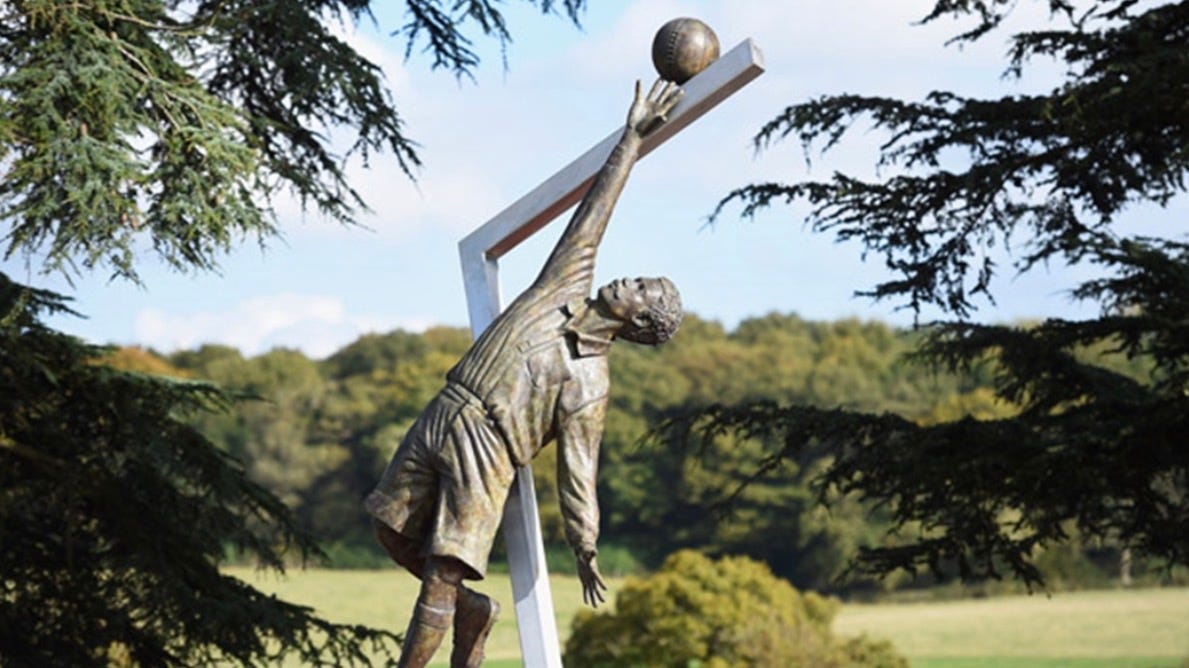
Just over 10 years later a 16-foot statue of Arthur was unveiled at St George’s Park, the home of the Football Association’s national football centre as a striking symbol of a footballer from 19th-century Ghana, who had once been buried in an unmarked grave, but now has a prominent place at the heart of English football and effectively and appropriately placing Arthur in the sphere of the modern game that he helped pioneer more than a century earlier.
Great topic, Harry. I remember the campaign for the statue. I think the people of Darlington who follow football are proud of him.