
After the Fire
Some photographs and some words...

After this, Britain is left deprived of all her soldiery and armed bands, of her cruel governors, and of the flower of her youth, who went with Maximus but never again returned.
The British writer Gildas, writing in the 6th century, describes Magnus Maximus, a usurper emperor based in Britain, who in 383, with the support of many troops in Britain, travelled to Gaul to defeat the legitimate Western Roman Emperor, Gratian.
A few weeks ago, I wrote in Following the Eagle about Segedunum, the Roman fort at the eastern end of Hadrian’s Wall, close to the River Tyne. In that piece, I mentioned Arbeia, the excavation of which I wrote of in A Striking Sight, an even larger fort about four miles further east on a hilltop at the river’s mouth. Today, its remains sit surrounded by schools and modern domestic dwellings of the town of South Shields.
As I mentioned in ‘Following the Eagle’, the soldiers at Hadrian’s Wall came from all over the Roman Empire, and Arbeia, meaning ‘fort of the Arab troops,’ was named after some of the soldiers once stationed there from what is now Iraq. It’s interesting to think about how they must have felt arriving at a damp, windy hill in northeast England.
Inscriptions on the excavated stones show that the Sixth Legion built the fort around 105 CE, though it’s unlikely they ever stayed there. Building such a large stone fort required specialised engineering skills, which only the Roman legions possessed. The auxiliary units that later garrisoned the fort didn’t have this training. So, it was the legions, especially the Sixth, who managed most of the construction at Arbeia.
Arbeia was an important military base established to defend the mouth of the River Tyne. The first unit stationed there was the Ala Primae Pannoniorum Sabiniana, a cavalry regiment of 500 horsemen from the Pannonian tribes in present-day Hungary. Sometime during the second century, they moved to Onnum (Halton Chester in Northumberland) and were replaced by another cavalry regiment, the Ala I Hispanorum Asturum, from the Astures tribe in present-day north-western Spain.
During the reign of Emperor Septimius Severus, a Gallic infantry unit, Cohors V Gallorum, with about 1,000 soldiers, replaced the Ala I Hispanorum Asturum cavalry unit. The infantry unit may have come from Fort Cramond in what is now Edinburgh on the River Forth, and it’s believed to have been only about half its full strength, possibly because some troops stayed behind at Cramond or spent time guarding supply caravans as they travelled between the forts.
Most people in the UK have heard of Hadrian, but few remember Emperor Septimius Severus, yet he spent the last three years of his life in Britain, arriving in 208 CE with a large army. Some say he came because the Governor of Britain asked for help to stop a rebellion. Others think he was simply tired of his sons, Caracalla and Publius Septimius Geta, arguing, so he brought them to Britain as a distraction. That’s certainly one way to manage family problems. The entire imperial family, including his wife Julia Domna and the court officials, moved to Britain and ruled the Roman Empire from what is now York until the emperor’s death.
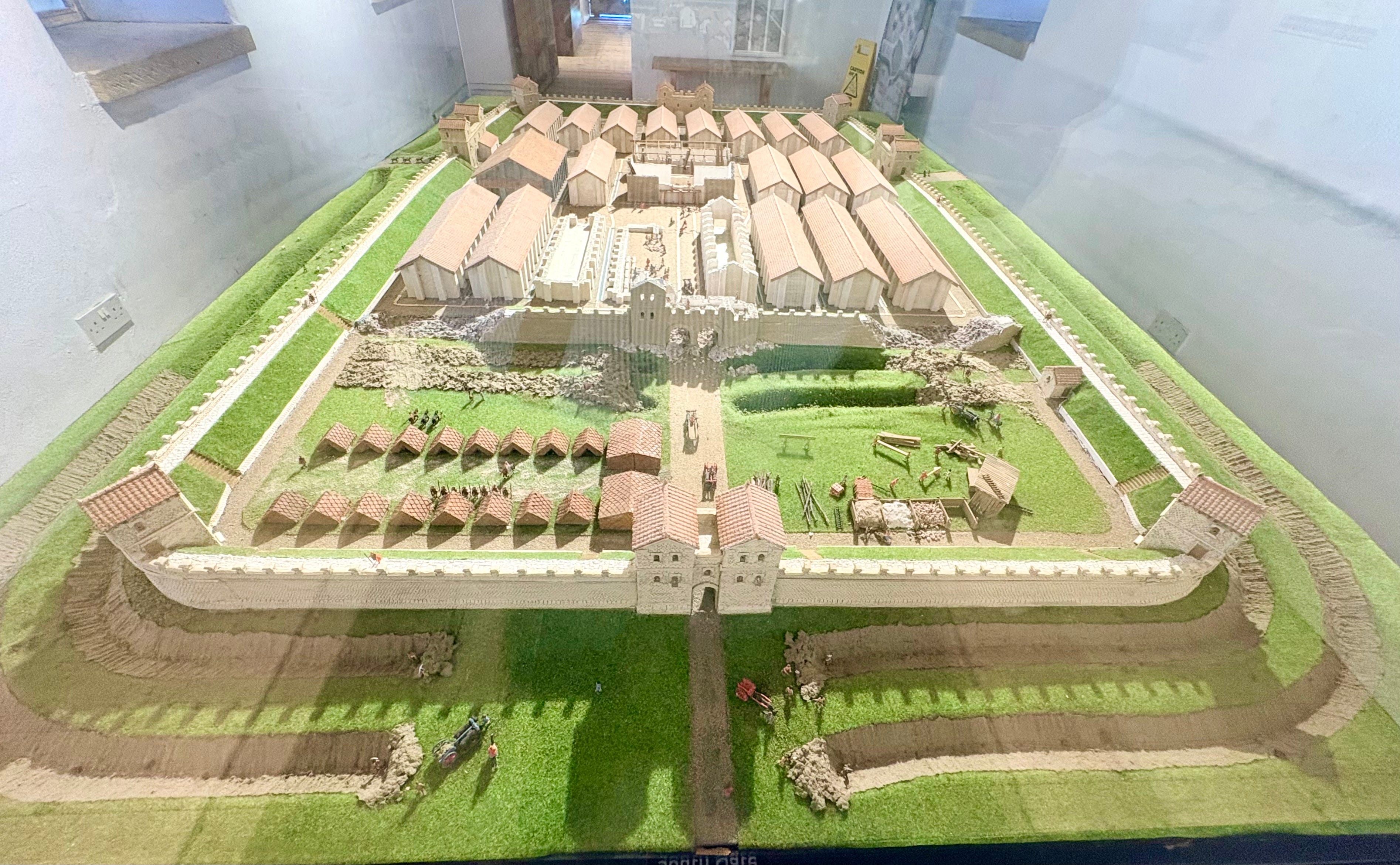
After arriving in Britain, Septimius Severus changed Arbeia from a regular fort to a supply base by demolishing most of the old buildings except for a double granary and replacing them with eighteen new stone granaries. Later, this number grew to twenty-four. Altogether, the granaries could hold up to eight hundred tonnes of grain, enough to feed about 25,000 people in the Roman forts and garrisons along Hadrian’s Wall. This expansion also saw the building of four new barrack blocks.
After expanding Arbeia, Septimius Severus began upgrading Hadrian’s Wall, and once that was complete, he led his large army north to try to defeat the Caledonians. This was a huge effort, as fighting in Scotland was difficult because of the rough terrain and skilled opponents who avoided direct combat. In the end, Septimius claimed a kind of victory (a trick employed by modern leaders, too), which allowed him and his sons to take the title ‘Britannicus.’
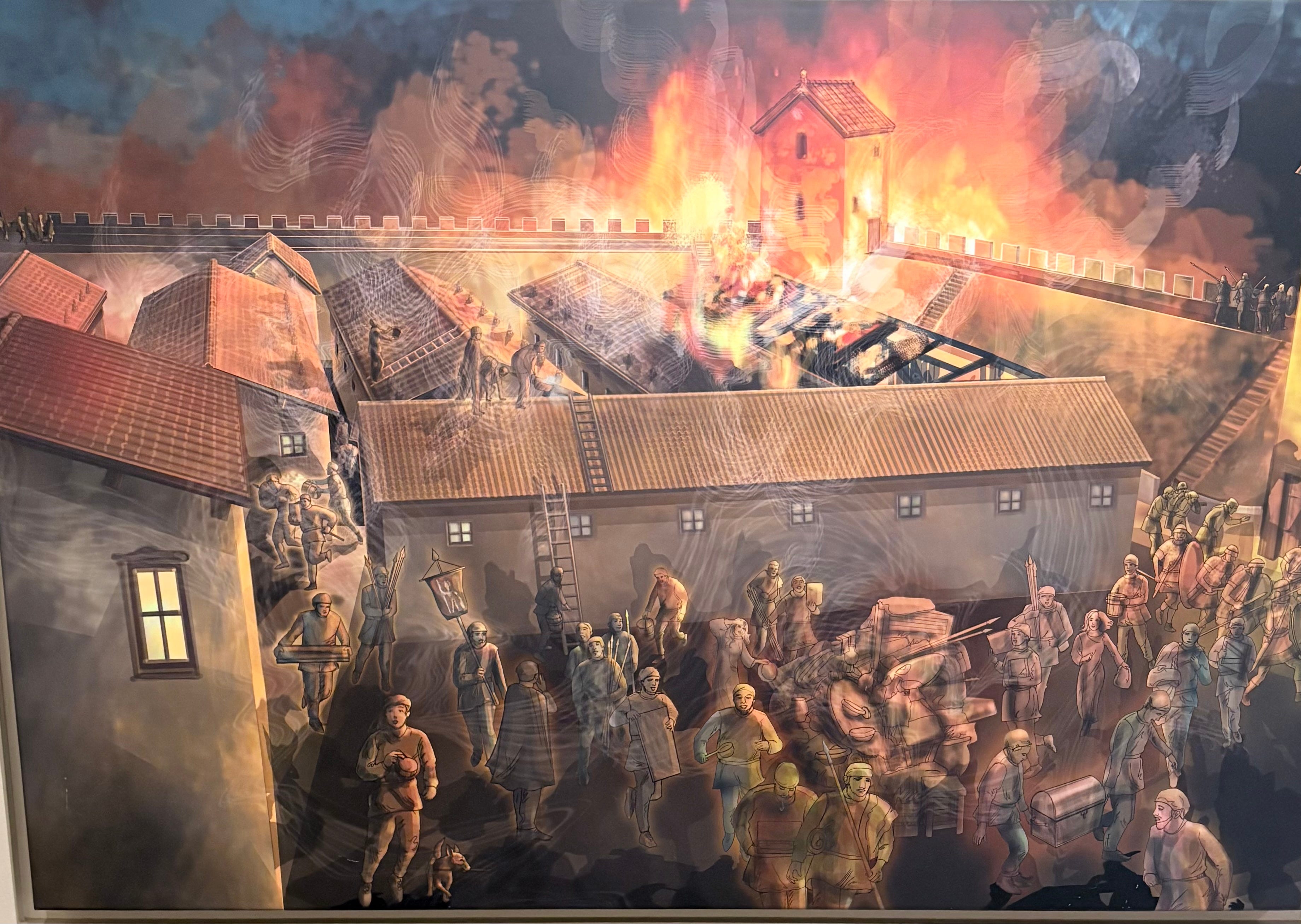
But my recent visit to Arbeia wasn’t about learning more about Septimius Severus. I went to see a new exhibition called ‘After the Fire,’ which highlights a dramatic but often overlooked event in the fort’s history, at the end of the 3rd or early 4th century, when a major fire destroyed or damaged many key buildings, including some of the large grain stores and living quarters.
It’s believed the fire resulted from an attack by Northern Tribes, possibly the Picts of modern-day Scotland and/or other northern British groups. The Picts were a major threat to the forts along Hadrian’s Wall, often taking advantage of any weakness in Roman defences, especially in the waning years of Roman occupation.
The exhibition explores the fort’s rebuilding and repurposing after the fire, in the context of Rome’s declining power, and shows how the story of Roman occupation of Arbeia shifted after the disaster to adaptation and survival, culminating in the end of their rule in Britain.
Using artefacts found during excavations that provide evidence of rebuilding, the exhibition shows how life went on after the disaster. The exhibition also places the fire within the broader context of late Roman Britain, a period known for instability, and presents it as part of the broader decline of Roman rule.
One of several important items discovered is a ring-mail shirt, now deemed the best-preserved in Britain. The shirt, worn over a padded garment for extra protection, was part of an auxiliary soldier’s kit. And this one belonged to a soldier from the Fifth Cohort of Gauls I mentioned above. Other items found in the remains include a precious gold ring, probably hidden by a soldier in his barracks who, for whatever reason, was then unable to retrieve it. You must remember how cramped the conditions in the barrack blocks were. Each block had five ‘apartments’ consisting of two small rooms, with each room occupied by eight soldiers with small, narrow beds and a fireplace or small hearth to offer warmth and a place to cook. Each soldier would therefore have had minimal personal space, and you can’t help imagining how the air must have had a rich aroma. With so little privacy, it was no wonder that soldiers took diligent care of their valuables, hiding them from prying eyes, only to make their retrieval much more difficult in an emergency.
Evidence shows that after the fire, some of the granaries were rebuilt as barracks, suggesting an increase in the number of troops stationed at the fort. The rebuilding programme also saw the construction of a new principia, the headquarters building, while the original principia became a granary. The increased number of barracks headquarters and a more impressive commanding officer’s house point to a shift in the Roman military’s focus from expanding their territory in the north to simply holding on to what they already controlled. Further expansion of the fort began between 220 and 235 and continued until at least 270.
The rebuilt fort showed off the latest designs from the eastern Roman Empire. The expanded principia was no longer in the centre of the fort but at the end of a grand processional road at the south, while two main roads divided the soldiers’ living quarters into four sections. The praetorium, the home of the fort’s Roman commanding officer, was now a large courtyard house modelled after a Roman townhouse, with rooms facing the open courtyard. It featured painted walls, private suites for the commanding officer and his family, baths, and large dining rooms for summer and winter, all designed to impress guests. The house served as both home and office, and you can now see a partial reconstruction on the site.
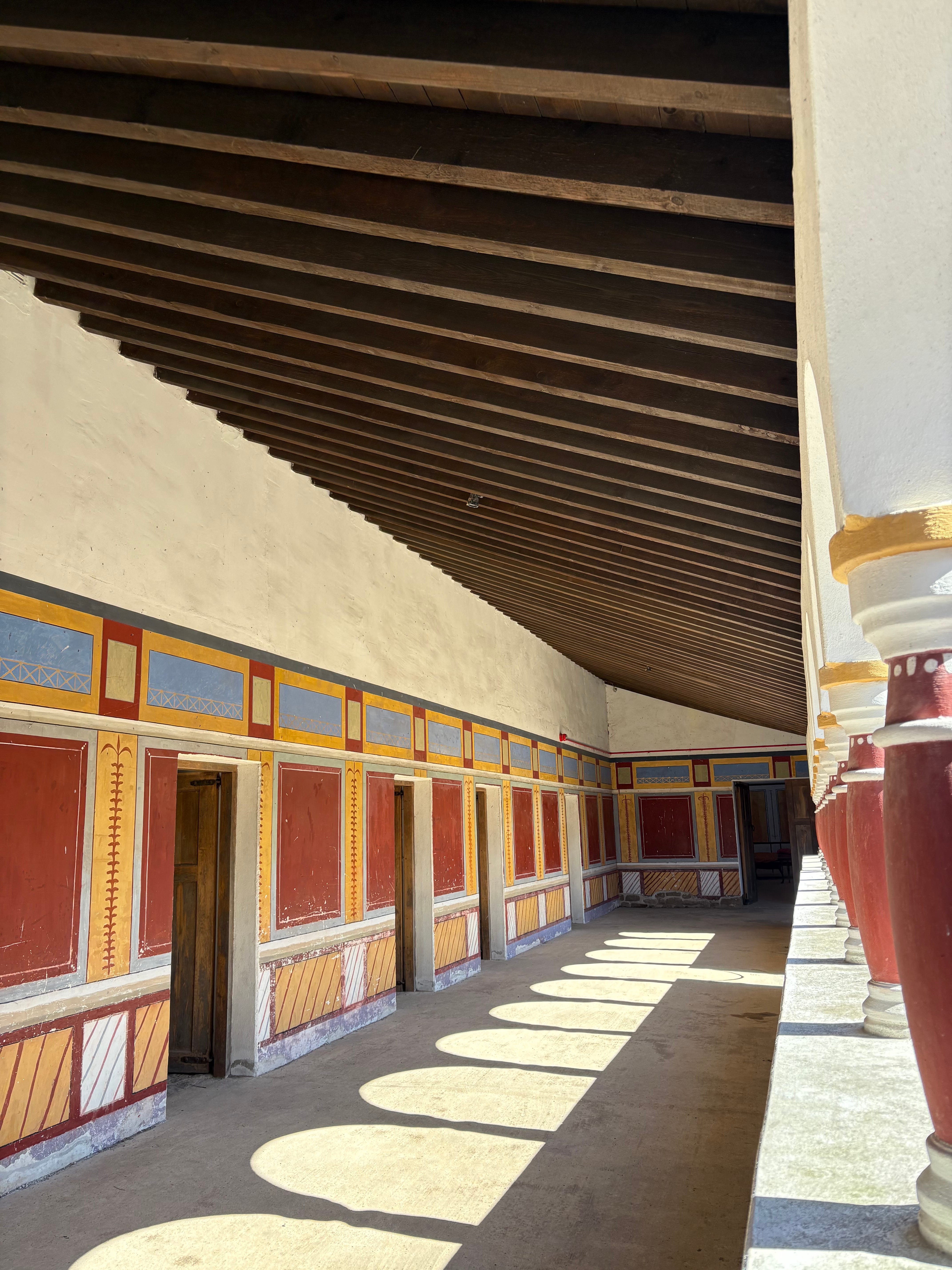
The house was in use for over a hundred years, and its original layout remained the same for about thirty years. After that, it must have become ‘tired’ looking and in need of renovation, as a new bath suite was installed. However, simpler designs were later used to cover the original elaborate wall paintings, probably indicating that the house (and thus the fort) was losing its importance. By the late fourth century, all the decorated plaster had disappeared, leaving the walls simply covered in white plaster. The grand summer dining room, once the largest room, had become just an open space with a rough stone floor.
The deterioration of the fort didn’t end there. From the mid-4th century onward, many small alterations occurred as Arbeia’s role as a supply base faded. There is evidence that the Tigris Bargemen were the last of the ‘Roman’ occupants, and at some point in the 4th century, the fort ceased to be used as a military base and became a civilian settlement.
This repurposing of the once Roman commander’s building might well have been to answer what was still a demand in the area for fine furniture and quality jewellery. Artefacts found on the site show that Arbeia had a lively community at the end of the fourth century, with a workshop set up in what had been the commanding officer’s private rooms, where people made wooden furniture such as boxes and chests with antler inlay. There was also evidence of food preparation in the courtyard, while in other parts of the fort, artefacts found reflect that workers made jewellery from jet, probably brought from present-day Whitby and Robin Hood’s Bay, on the coast further south of Arbeia.
But I’ll end with one mystery that remains, and it’s the story behind the killing of two young men in the house’s final days, around the end of the 4th Century, some years after the Romans withdrew from Britain, never to return. The men’s skeletons reflect a violent death, and afterwards their bodies were left exposed to the elements long enough for dogs to gnaw the bones before the burial of what remained in the courtyard of the house. Perhaps the two men were former Roman soldiers who became craftsmen, but for some reason, they fell out of favour with the locals? Or maybe just a dispute between locals. We’ll never know.